
Blog
From Garage to Global Empire: The History of Amazon
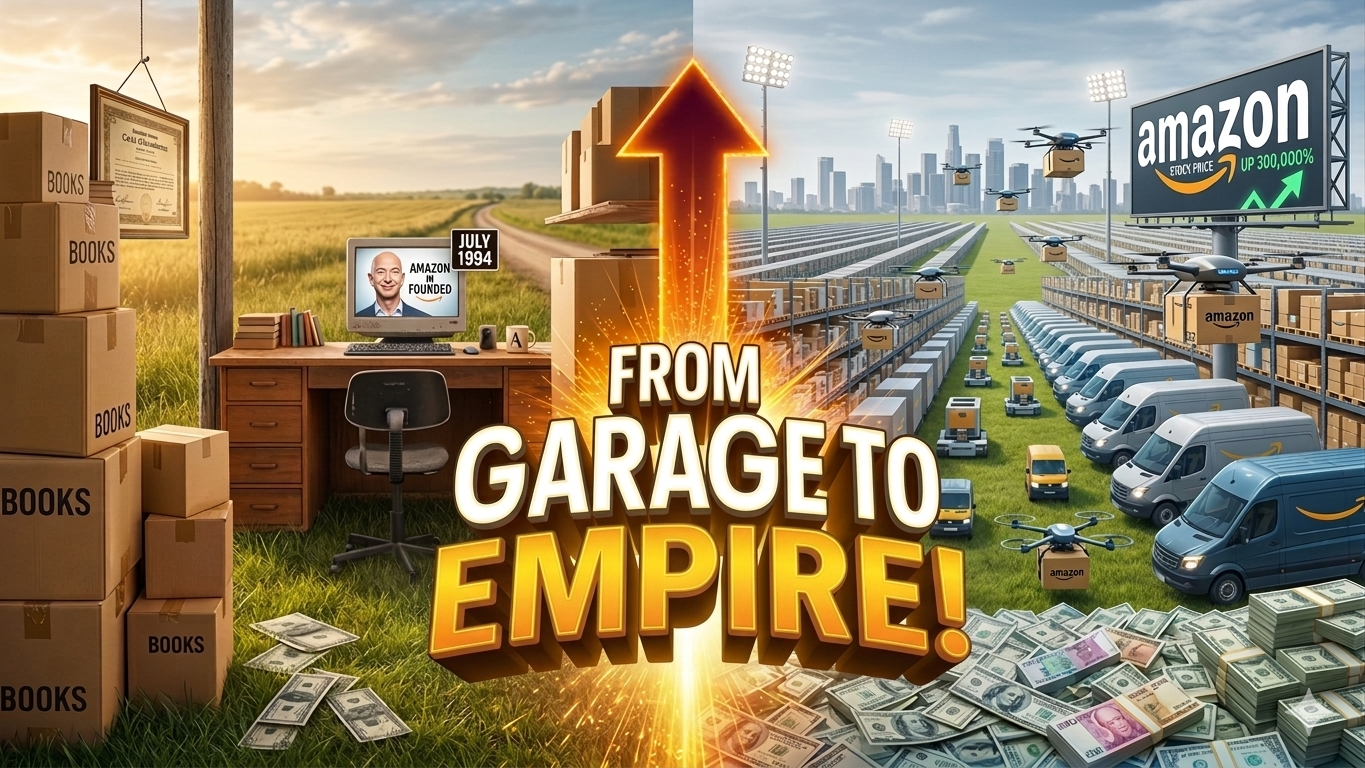
Jeff Bezos started Amazon in a garage selling books. Thirty years later it's one of the most powerful companies on Earth. Here's how it happened.
Quick answer
Amazon was founded in 1994 by Jeff Bezos, who left a Wall Street job to sell books online from his Seattle garage. It launched in 1995 as 'Earth's Biggest Bookstore', survived the dot-com crash, and transformed consumer behavior in 2005 with Amazon Prime. Over the following decades it expanded into electronics, cloud computing (AWS, launched 2006), media (Kindle, Amazon Studios), and physical retail (Whole Foods acquisition in 2017) — evolving from a bookstore into one of the most powerful infrastructure companies in the world.
1994–1999: The Garage, the Books, and 'Earth's Biggest Bookstore'
In 1994, Jeff Bezos was working on Wall Street when he stumbled across a statistic: internet usage was growing at 2,300% per year. He made a list of products that could be sold online and landed on books — easy to package, nearly impossible to damage in transit, and available in more varieties than any store could physically stock.
He drove cross-country to Seattle, wrote the business plan in the passenger seat, and launched Amazon.com from his garage in 1995 under the tagline "Earth's Biggest Bookstore." Within the first month, Amazon had shipped books to all 50 U.S. states and 45 countries.
Bezos chose books not because he loved books — he chose them because they were the most scalable product he could find for an early internet store.
- First-month revenue: $20,000/week — far beyond initial projections.
- Early employees packed orders on their knees on the warehouse floor.
- The name "Amazon" was chosen to suggest something vast and the start of the alphabet.
- Bezos called his strategy the "regret minimization framework" — he didn't want to wonder "what if" at 80.
2000–2004: Surviving the Crash When Everyone Else Didn't
The dot-com bubble burst in 2000, wiping out hundreds of internet companies overnight. Amazon's stock dropped from $107 to $7. Analysts predicted it would go bankrupt. It didn't.
Bezos cut costs aggressively, stayed focused on customer experience, and used the crash to expand while competitors collapsed. Amazon moved beyond books into electronics, toys, clothing, and tools — building the infrastructure of a universal store while others were shutting down.
While the dot-com crash destroyed most internet retailers, Amazon used it as a buying opportunity — cheaper talent, less competition, room to build.
- Amazon launched its Marketplace in 2000 — letting third-party sellers list products alongside Amazon's own inventory.
- By 2002 it had reached its first annual profit.
- The decision to open the platform to competitors was controversial inside the company — and ultimately one of its best moves.
2005: Amazon Prime and the Loyalty Program That Changed Retail Forever
In 2005, Amazon launched Prime: a flat annual fee (originally $79) for unlimited free two-day shipping. The idea seemed financially reckless — shipping is expensive, and Amazon was essentially promising to absorb that cost indefinitely.
The psychological effect was the real product. Once customers paid the annual fee, they had a reason to shop Amazon first for everything — skipping the comparison-shopping they might otherwise do. Prime members spend significantly more per year than non-members, and churn is extremely low.
Prime didn't just build loyalty — it changed the baseline expectation of online shopping. Two-day delivery went from a luxury to the standard.
- Prime has grown to over 200 million subscribers worldwide.
- It has expanded to include streaming video, music, reading, and grocery delivery.
- The annual fee has risen to $139 — and renewal rates remain above 90%.
- Prime is widely credited with making Amazon the default starting point for online purchases.
2010–Present: Media, Groceries, Cloud, and the Everything Store
The last fifteen years have seen Amazon expand into industries that would have seemed far-fetched in the garage days. The Kindle (launched 2007) disrupted the entire publishing industry. Amazon Studios produces Oscar-winning films and prestige television. The 2017 acquisition of Whole Foods for $13.7 billion signaled a serious move into physical grocery retail.
Meanwhile, Amazon Web Services — launched quietly in 2006 as a side project to rent out Amazon's spare server capacity — became the backbone of the modern internet and Amazon's most profitable division by far.
- Kindle made e-books mainstream and gave Amazon control over the digital reading market.
- AWS now powers Netflix, Airbnb, NASA, and a huge share of the web's infrastructure.
- Amazon Studios has produced 12 Academy Award-winning films.
- Whole Foods gave Amazon 500+ physical locations and a foothold in premium grocery.
- Amazon now employs over 1.5 million people worldwide.
What Amazon's Story Actually Teaches Us
Amazon's trajectory isn't just a company history — it's a case study in a specific kind of strategic thinking: long-term over short-term, infrastructure over margin, and platform over product.
Every major Amazon move followed the same logic: build something that scales, open it to others, and collect a toll. Books became a marketplace. Servers became AWS. Delivery became Fulfillment by Amazon. The store became the infrastructure.
The pattern behind every Amazon expansion: build it for yourself, then rent it to the world.
Build your personal plan
Ready to practice Business Strategy?
Get a step-by-step learning route tailored to your level — with quizzes and hands-on tasks, not just theory.