Blog
Machine Learning Roadmap: From Zero to Real Models
A practical, structured path into machine learning — from the math you actually need to your first working model, without drowning in theory you'll never use.

Quick answer
Learning machine learning efficiently means starting with a real problem and a simple model — not math proofs or deep neural networks. Focus on data preparation first (it's 70% of real ML work), learn the five core problem types, and build the full pipeline — raw data to evaluated model — before moving to advanced techniques. Strong fundamentals let you learn new tools quickly as the field evolves.
Why Most Machine Learning Tutorials Fail Beginners

The typical machine learning tutorial dumps math notation, neural network diagrams, and a thousand library calls into your first hour — then expects you to be inspired. Most people close the tab and never come back.
The fix is not a smarter tutorial. It's a better sequence — a roadmap that starts with the problem, then the data, then the simplest possible model that solves it.
The right order: problem → data → simple model → evaluate → improve.
- Mistake 1: starting with theory instead of a real problem.
- Mistake 2: jumping to neural networks before understanding regression.
- Mistake 3: cargo-culting code without knowing what each line does.
What Math Do You Actually Need to Learn Machine Learning?

You don't need to derive backpropagation from scratch to build useful ML systems. You need enough math to understand what your model is doing — and when it's failing.
Start with the intuition, not the proof. You can always go deeper once you have context for why the math matters.
- Statistics: mean, variance, distributions, correlation — understand these intuitively.
- Linear algebra: vectors, matrices, dot products — mostly via NumPy, not by hand.
- Calculus: understand that gradient descent finds minimums — you don't need to compute gradients manually.
- Probability: understand likelihoods and Bayes' theorem at a conceptual level.
Why Data Preparation Matters More Than Algorithm Choice in ML
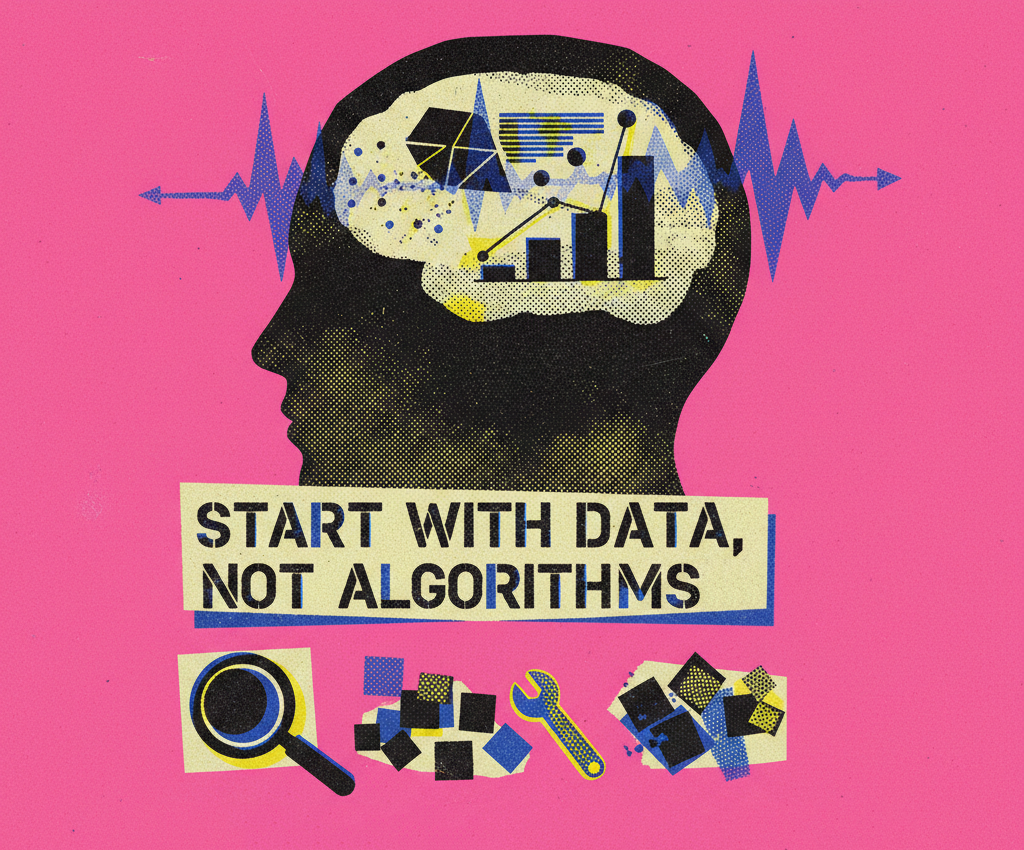
The biggest mistake in machine learning is treating data preparation as a step to rush through to get to the 'cool' modelling part. In reality, 70% of real ML work is data: collecting, cleaning, exploring, and transforming it.
Build strong data instincts first. The rest follows.
Every good model starts with someone who understood the data deeply.
- Explore before modelling: distributions, missing values, outliers, class imbalance.
- Visualize everything — a plot reveals what a table hides.
- Feature engineering often beats algorithm choice.
- Know your target variable: is it classification, regression, or ranking?
5 Machine Learning Problem Types Every Beginner Should Master
Don't try to learn every algorithm. Learn the five core problem types and the go-to model for each. Once you can solve these, you can handle 90% of real-world ML tasks.
- Binary classification: spam detection, churn prediction (start with logistic regression).
- Multi-class classification: image labels, topic tagging (random forests → then neural nets).
- Regression: price prediction, demand forecasting (linear regression → gradient boosting).
- Clustering: customer segmentation, anomaly detection (K-Means, DBSCAN).
- Recommendation: product suggestions, content ranking (collaborative filtering basics).
How to Build Your First Machine Learning Model Step by Step
The best first project is a tabular dataset with a clear target — like predicting house prices or classifying emails. Avoid image and text data until you understand the fundamentals on clean, structured data.
Work through the full pipeline once: load data → split train/test → train model → evaluate → tune → repeat. This loop is the core skill.
- Week 1: linear and logistic regression on Kaggle's Titanic dataset.
- Week 2: decision trees and random forests — understand how they split data.
- Week 3: gradient boosting (XGBoost/LightGBM) — the workhorse of real ML.
- Week 4–5: a simple neural network with PyTorch or Keras on a classification task.
How to Stay Current in Machine Learning Without Getting Overwhelmed
AI moves fast. The key to keeping up is not reading everything — it's having strong fundamentals so you can learn new tools quickly and evaluate claims critically.
Follow a few high-signal sources, build something small with each major new tool, and focus on understanding principles over memorizing APIs.
- Read papers via abstracts first — then full paper only if relevant to your work.
- Apply Pareto: 20% theory, 80% building with new tools.
- Join one focused community (Hugging Face forums, fast.ai, Kaggle discussions).
- Every 3 months: rebuild one old project with a newer, better approach.
Build your personal plan
Ready to practice Machine Learning?
Get a step-by-step learning route tailored to your level — with quizzes and hands-on tasks, not just theory.